27 November 1997 -1999 ©
I've decided to make cloning one of the first topics in this first
issue of Science Explained because the folks
who created Dolly are acquaintances of mine. (Yes, I am a name
dropper, aren't I?) A few kilometers from my home lives Dolly,
the world's first mammalian clone; not counting identical twins.
(They're clones too.)
What makes Dolly different from identical twins
is that she was grown from a cell taken from an ADULT animal!
Many bright, well-respected scientists said it couldn't be done.
Dr Ian Wilmut, who is in charge of the lab that created
Dolly, admits that he had his doubts. However the hard work and
imaginative thinking of his staff made it all possible.
|
How did they do it and what did they do?
First some background to teach you the basics of developmental
biology.
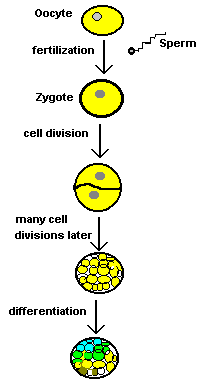
A cell from a frog's gut should always remain a frog-gut-cell because it has "differentiated". Differentiation is the natural process whereby cells specialize into a certain kind of cell. As a frog embryo grows and develops its cells differentiate into nerve cells, blood cells, fat cells and many other different kinds of cells. That's what differentiation is all about. Differentiation is important because without it an animal could never be anything but a blob of unspecialized cells. As a mass of embryo cells divide and differentiate they "create" the animal. This incredible process of differentiation turns zygotes into animals and it's all controlled by the genes. Although the exact process is still poorly understood, scientists agree that differentiation must have something to do with changes in the nucleus of cells. You may recall that the nucleus is the part of the cell containing the genetic material (the DNA all coiled up in organized structures called chromosomes). |
|
What do frog cells have to do with Dolly?
|
Like most scientific "breakthroughs" the earlier work
done by others provided the foundation on which to try something
new.
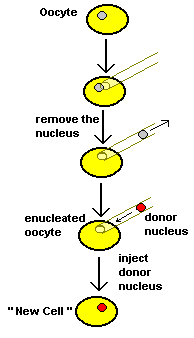
Decades ago a fellow named Gurdon developed the method of "nuclear transfer". This is a two step process. First he used delicate needles and a good microscope to suck out the nucleus from a frog oocyte, producing an "enucleated oocyte". (That's an oocyte without a nucleus.) With the genetic material removed the enucleated oocyte would not divide or differentiate even when fertilized. That was no surprise. (A cell is nothing without its nucleus.) But the results from Gurdon's second step shocked a lot of people! He used the same equipment and skill to transfer the nucleus from a frog's gut cell into an enucleated oocyte. That's nuclear transfer, the transfer of a nucleus from one cell to another, creating a "new cell" with a different nucleus. Many of these new cells which Gurdon created behaved like a zygote. They divided and divided and divided just like a normal developing embryo, producing a ball of cells. And this ball of cells differentiated! Nerve cells, skin cells, blood cells appeared just as they would in a normal embryo. After the normal length of time Gurdon had tadpoles! Because the tadpoles had all come from the gut cells of the same adult, they all had the same genetic material. So they were all clones, identical twins of each other. But unlike normal identical twins they were made from differentiated cells. |
Naturally this got a lot of scientists thinking about cloning. But there were two problems.
First, Gurdon's nuclear transferred tadpoles never grew into frogs! Other folks repeated his experiments and got similar results. Nuclear transfer couldn't clone frogs from frog cells; all you got were tadpoles. No one knew why. Even today, no one knows why the tadpoles made by nuclear transfer die instead of growing into frogs. Weird.
The second problem was that Gurdon's method seemed to work only with frogs (or perhaps I should say "tadpoles"). When scientists tried nuclear transfer with mice, cattle or indeed any mammal, they got nowhere. The "new cells" sometimes divided a few times, but not for long and none of them differentiated properly. You just couldn't clone mammals. By the early 1980's most scientists accepted the idea that something very special allows frogs to be (partially) cloned (into tadpoles). Whatever that process was, it was not found in mammals. The textbooks made it very clear. Differentiation was (sort of) reversible in frogs but not in mammals.
Bummer.
So what exactly did the scientists at the Roslin Institute do?
Well, Keith Campbell, a fellow working for Dr Wilmut, thought that maybe the cell cycle had something to do with this cloning trouble.
|
The cell cycle is often described as a circle of
cell life and division, but I think that can be a bit confusing
for some people, so let's try to remember that by "cycle"
we mean it happens again and again.
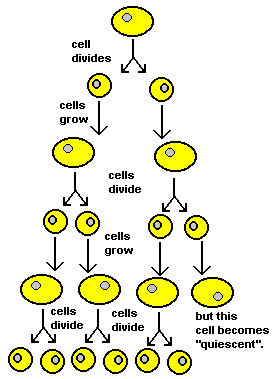
A cell divides into two "daughter cells" and both of these cells live, "eat", grow, copy their genetic material and divide again producing two more daughter cells. Because each daughter cell has a copy of the same genes in its nucleus, daughter cells are "clones" of each other just like identical twins. This "twining" goes on and on with each cell cycle. This is a natural process. The cell cycle fascinates biologists. Very fast cell cycles occur during development causing a single cell to make many copies of itself as it grows and differentiates into an embryo. Some very fast cell cycles also occur in adult animals. Hair, skin and gut cells have very fast cell cycles to replace cells that naturally die. And cancer is a disease caused by cells cycling out of control. It's no wonder that biologists think the cell cycle is so important. But there is a kind of "parking spot" in the cell cycle called "quiescence" (pronounced "kwee-S-ence"). A quiescent ("kwee-S-cent") cell has left the cell cycle, it has stopped dividing. Quiescent cells might reenter the cell cycle at some later time, or they might not. It depends on the type of cell. Most nerve cells stay quiescent forever. On the other hand, some quiescent cells may later reenter the cell cycle in order to make more cells. (For example, when a young girl starts to develop breasts.) |
|
Many biologists (including myself) thought that to make a clone you should transfer the nucleus from a fast dividing cell. It made sense because fast cycling cells are exactly what makes an embryo grow. Besides, the gut cells used to make the tadpole clones were fast cycling cells. Many biologists tried to make clones by transferring the nucleus from fast dividing cells but all of those experiments were unsuccessful. (I tried injecting the fast growing cells from chicken feathers into hen eggs in the hope of cloning birds, but it didn't work.)
Keith (Dr Campbell) thought about it in a different way. He wondered
if a quiescent nucleus would be a better donor. True, it was not
cycling (that's what makes it quiescent, by definition) but Keith
thought maybe that's what the nucleus needs for it to be successfully
transferred. Maybe the cell needs time to "rest" before
starting to make a whole new animal. Maybe the nucleus needs time,
lots of time, to get its DNA in order. Maybe...?
Maybe quiescent cells would work!
So they tried it with cells from sheep.
The folks at the Roslin
Institute do a lot of work with sheep as part of their partnership
with a company called Pharmaceutical Proteins Limited Therapeutics
(PPL Therapeutics). Earlier they had made transgenic sheep (sheep
with human genes transferred into them, but that's another story).
They used cells from an adult sheep's mammary (breast) glands
for the "donor" nucleus. They grew the cells in tissue
culture, an artificial situation that is commonly used in
laboratories to grow large numbers of cells in bottles. Tissue culture allows scientists to fiddle with
the cells and alter their characteristics. That is exactly what Dr
Campbell did. He "starved" the cells of important nutrients
and the cells stopped growing and dividing. They became quiescent.
(Keith knew they would become quiescent when starved of nutrients
because other researchers had proven that years ago; but few folks
really cared because who needs quiescent cells?)
|
And then he made Dolly?
Yes, but creating Dolly was not easy.
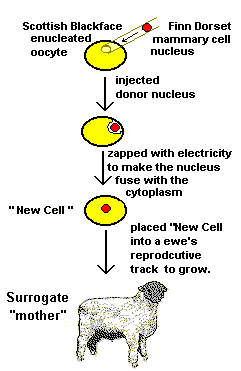
Oocytes have a "shell" of proteins and fibers (called the zona pellucida) and it is through this protective coat that Bill injected the nucleus from a quiescent mammary cell into the enucleated oocyte. That cell nucleus was from a different breed of sheep called a Finn Dorset, which happens to be a pure white breed of sheep. He then used a tiny pulse of electricity to cause the new nucleus to fuse with the enucleated oocyte's cytoplasm. (Cytoplasm is the solution inside the cell.) This electricity also helps "kick start" cells into "activity" so they are more likely to divide. This new, fused cell (containing the Finn Dorset mammary cell nucleus in the cytoplasm of a previously enucleated Blackface oocyte) was transferred into the reproductive "chamber" of a Blackface ewe (the same breed that provided the oocyte). |
Bill and his fellow researchers than repeated this process 276 times! That's right, 276 times.
I told you this wasn't easy.
|
After 148 days, a normal length of time for the Finn Dorset breed
of sheep, Dolly was born.
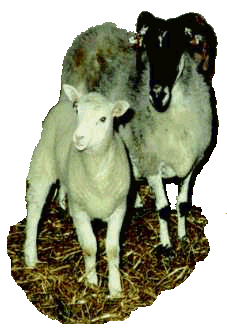
As you can see she is a healthy, normal looking Finn Dorset. (Dolly's the wee one on the left) born to a Blackface ewe (her mom's on the right). This proves that Dolly wasn't the product of a sneaky mating; Dolly's Blackface mom could not produce a white faced sheep no matter who was the father. (It has to do with the genetics of sheep breeds.) But just to be sure, the scientists DNA "fingerprinted" Dolly and her "mom" and proved that Dolly's DNA matched the cells from the tissue culture, not the cells from the ewe that gave birth to her. Dolly is a normal (Finn Dorset) sheep. Contrary to the reports in some of the trash newspapers, she has not eaten her keeper or her fellow sheep. She does not shoot laser beams out of her eyes or talk. Dolly is a friendly, normal, healthy sheep who enjoys being petted, especially if you have some food in your hand! |


If you have a comment or question about cloning feel free to send a
Letter to the Editor.
I can't promise to answer all your questions or address all your comments, but I'll post a few particularly good ones here.


Want to create a flock of cloned sheep?
Here's your chance! Visit the Esheep Homepage and download the silly, little program that creates entertaining sheep on your desktop. Each time you run Esheep.exe a cute cartoon sheep appears. Create as many as you want! They will wander around your desktop interacting with each other and entertaining you. Double click on the sheep to call up the Esheep options box with the "remove" feature that causes the sheep to go away. You can always call them back by running Esheep.exe again (and again, and again)! |
Ok, I'm not being very scientific here but these things are fun. The free version is enough entertainment for me but you might want to register yours and get the extra features. |
Hani writes from South Africa ...
Why did the process have to be repeated 276 times? Don't the cells divide or is it because the experiment failed 276 times?
The short answer is that the experiment failed 276 times. To understand the failures we need to know more about the way the researchers did their work.
The Roslin team knew from previous research on embryo transfers (moving embryos into a different mother) that the transfers don't always work. The embryos may die for various reasons. They also knew that the nuclear transfer itself might introduce new ways for things to go wrong. Remember, they had to inject the nucleus through the enucleated oocyte's protective coat (zona pellucida), zap it with electricity and hope that the nucleus would have become quiescent during its time in tissue culture. Any of these new steps might cause the embryo to die or never develop. In order to better understand what might be going on the researchers introduced a step I failed mention.
|
First a little more background information about developmental
biology. A few days after normal fertilisation a zygote would
be expect to have divided approximately four times, producing
a ball of 16 cells. (Think about the math. That's 1---> 2---> 4---> 8--->16)
At this point in its development the embryo looks like a tiny
mulberry and is called a morula. ("Morula" is
Latin for "mulberry".) Soon after this stage the zona
pellucida (the "egg shell") starts to disappear and
as the cells continue to divide they allow fluid to enter the
center of the mass of cells. This forms a hollow ball, with cells
on the outside and fluid inside. This is called a blastocyst.
All mammals (including you and me) developed from zygote, to morula
and then to blastocyst, before implanting into the wall of mother's
uterus. These are very important steps in our development and that
of a lamb.
Anyway, a few days after placing the "new cells" into ewes' oviducts, the researchers collected them to see how well they had developed. As you might imagine it is not easy to find a tiny morula or blastocyst in a sheep's oviduct. Of the 277 they put into ewes they recovered only 247. That means over 11% of the embryos were lost in the first few days. Some may have been lost because they are so difficult to find. Others may have died early and decomposed. Unfortunately, when they examined each of them under the microscope only 29 of the 247 recovered were either a morula or a blastocyst. Or to put it another way, 88% of the "new cells" transferred had not developed. That's a significant loss in the experiment. The researchers then placed the remaining 29 "good embryos" into 13 ewe's. Some ewes got only one embryo, some got two (which is the average number of lambs that ewes have at a time) and some ewes got three embryos. The exact number depended upon availability of the embryos at the time and the availability of "receptive" ewes. Ewes, like all mammals, must have the right balance of hormones in order to "adopt" an embryo at its particular stage of development. If the embryo and ewe are not "synchronized" (the phrase used for this balance) the embryo will not implant in the ewe's uterus. This is not an easy thing to do and the Roslin researchers explain in their paper "Not all recipients were perfectly synchronized." Perhaps that's why only one of those 13 ewes actually became pregnant. Of course, that was the one that gave birth to Dolly! |
|
The difficulty seems to have been in the ability to actually "reprogram" the "new cell" to behave like a zygote. Their success rate for this important step was 12% (29 "good embryos" from 277 "new cells"). There was also a high loss in the last stage, when only one embryo (Dolly) actually "took". This is a much higher rate of embryo loss than expected from a natural mating and is probably due to the manipulations of the morulas and blastocysts as well as the difficulty "synchronizing" the ewes. That means the total success rate was only 0.4% (1 lamb per 277 "new cells" made by nuclear transfer).
Hani goes on to ask ...
If Dolly were to receive a heart or liver from her twin, would her body recognise the new organ as a foreign body or would it accept it as its own?
Dolly doesn't have a living "twin". Her nucleus came from the tissue cultured mammary (breast) cells of a sheep now dead. If any one of those other 276 "new cells" had made it to birth then Dolly would have had a twin.
But I know what you are asking and it's an excellent question! Organ transfers from identical twins are usually accepted as if they had come from the same person. I say "usually" because, as in most of medicine, there are complication and exceptions, but these are fairly small in number. Therefore it would be a safe bet that organs could be swapped among clones without rejection.
Hani concludes her letter asking ...
If we were to clone a Bill Gates, would the clone have the same high IQ and photographic memory as the original? Would the clone have the same tempestuous personality as the original?
Probably not. IQs, photographic memories and personalities are formed by a combination of genes AND environment. Bill Gates' clone would have all the genetic foundation on which to build those traits but it takes many years of environmental influence to shape the final "person". If Mr Gates were to raise his clone in a suitable environment, "Billy-two" might have an even higher IQ, better memory and be even more tempestuous! Or maybe Billy-two would just be an easy-going, stupid kid. Nobody knows which individual genes or environmental factors shape these complex behaviors, but most scientists agree that it is a combination of nature (genes) and nurture (environment). How much does each contribute? Well, that's when you can sink into a heated debate (in the newsgroups, not here!). Opinions are free because that's what they are worth. Data is what makes science valuable and science is the only way to settle such a debate.
I recall one very good study done a few years ago. A researcher at the University of Minnesota compared the IQs of identical twins (clones) and "non-identical" twins (of the same sex). He concluded that genes were responsible for about half the similarity of the IQs of the identical twins, and the rest of their IQ was due to their environment.
Hani's last question leads to the obvious question of, "How hard would it be to clone a human?"
No one knows. Again, there are plenty of opinions. Certainly anyone thinking about trying it would have to find a more efficient method of cloning mammals. S/he would also have to recruit a lot of women willing to donate both oocytes for the nuclear transfer as well as the use of their uterus in order to grow the clone. Also, there's no guarantee that the same technique would work with humans. Maybe it only works with sheep. After all, Gurdon's cloning of frogs (tadpoles) didn't open the door to cloning humans. These same problems would also have to be considered by folks hoping to clone endangered species. Anyone cloning humans would have to tolerate the "moral outrage" (opinions) of those who see this as an evil idea. Anyone cloning an endangered species would probably be praised. (Probably.)


Makala from Arizona wrote to tell me ...
I am getting very confused. Some say Dolly is fake some say she is real. I would really appreciated it if you would tell me, just a simple Yes or No!
Yes, Dolly is a real clone. There are two reasons why people insist
she is a fake.
1. Some folks just like to "cause trouble" or refuse
to believe certain things that are beyond their ability to understand.
2. Dolly's mitochondria (tiny organelles inside the cell that
give it "power") are NOT cloned! This is a very minor
detail but an explanation is in order.
Mitochondria contain less that 1% of 1% of the genes in a cell. (They are an interesting part of the cell and you can find lots about them on the web by doing a search.) Dolly's mitochondria are from the enucleated egg from which she was created, not from the original cell. Recall that the folks at the Roslin Institute injected a nucleus (not mitochondria) into the enucleated oocyte. That means all of Dolly's nuclear DNA is cloned but not her mitochondria.
The fact that Dolly's mitochondria are not cloned comes as no surprise to folks who did the experiment or who understand the details. Sadly, some people like to make a big deal out of nothing and they enjoy dismissing the hard work and success of others. People who say Dolly is a "fake clone" either do not know what they are talking about, love conspiracy theories or try to look smug by pointing out this tiny detail about Dolly.
Mitochondria are unusual, genetically speaking. For example, we inherit half our nuclear DNA from our father and half from our mother but we get ALL our mitochondria from our mother! People who call Dolly a "fake" could also claim that a father is less of a parent that a mother because the child has its mother's mitochondria not its father's! They might go on to claim that (for example) Chelsea Clinton is not President Clinton's daughter because she does not have any of Bill Clinton's mitochondria. Obviously that is silly but it is also a great way to get people's attention and to raise a trouble. That is exactly the kind of "logic" being used to claim that Dolly isn't a clone.
I hope I have cleared up the confusion.


Dr Jamie Love, the editor of this website and all of Science Explained, has written several self-study science courses specifically designed for home schoolers and other distance learners. These courses are "hypertextbooks" - delivered over the internet and read on your computer, just like web pages.
To organize and distribute these hypertextbooks, Jamie created Merlin's Academy - a (non-accredited) "virtual school". Merlin's Academy sells self-paced, self-learning hypertextbooks that teach Alchemy (actually, Chemistry ),
Astronomy and
Genetics in a fun and unique way.
|


Return to the Science Explained Homepage.