
 and licensed under a Creative Commons Attribution-ShareAlike 4.0 International License.
|
Teacher's Study Guide for Lesson Two
by Dr Jamie Love |
|
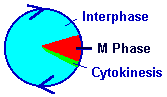
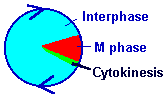
The cell cycle is a series of stages through which a eukaryotic cell passes between divisions and it is composed of three stages easily identified through the microscope.
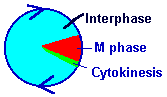
| 1. Interphase between divisions nothing seems to be happening. |
|
2. Nuclear Division is when the genetic material is divided and you can see the chromosomes.
Two types of nuclear division - mitosis and meiosis. Therefore this is often called M phase. |
|
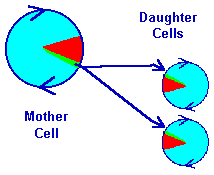
3. Cytokinesis divides the cytoplasm of the mother cell
into two daughter cells.
This is "true" cell division. |
Interphase dominates the cell cycle and is often called the "gap phase" in the cell cycle because it represents a period in which nothing seems to be happening. We often abbreviate it as G phase.
DNA is synthesised during G phase and it divides G phase into two other gaps (separated by the period of DNA synthesis).
So, interphase (G phase) is subdivided into
|
|
(If a cell had 1 picogram of DNA at G1 how much DNA would it have at G2?)
[2 picograms.]
|
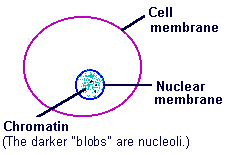
Interphase occurs between (both nuclear and cellular) divisions.
Easily identified through the microscope because the nuclear envelope is intact throughout interphase
|
|
|
G1 = "early interphase"
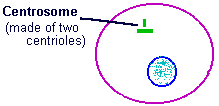
Cells in G1 have only one centrosome.
Centrosome is the major organizer of chromosome movement
in M phase.
|
|
During S phase each single chromatid (inherited from the previous nuclear division) is duplicated to give us the identical sister chromatids we see later on as X-shaped chromosomes.
|
G2 = "late interphase"
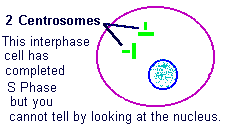
Centrosome is duplicated so by late G2 the cell has two centrosomes. It is crucial that the centrosome replicates during G2 because a cell must have two centrosomes to guide the chromosomes during the M phase that follows. |
|
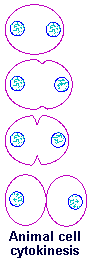
Cells entering cytokinesis have TWO nuclei (from M phase).
During cytokinesis the cytoplasm is divided.
This is "true" cell division.
|
Animal cells do not have a cell wall so they divide by a method
called furrowing.
During furrowing the cell membrane puckers inward along the cell's "equator" as if an invisible thread were tightening between the two parts. Eventually the furrowing pinches the cell in two. The "thread" is actually fibers of proteins attached to the inside of the cell membrane and they constrict like a muscle.
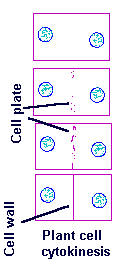
Plant cells have cell walls so they cannot divide by furrowing.
|
|